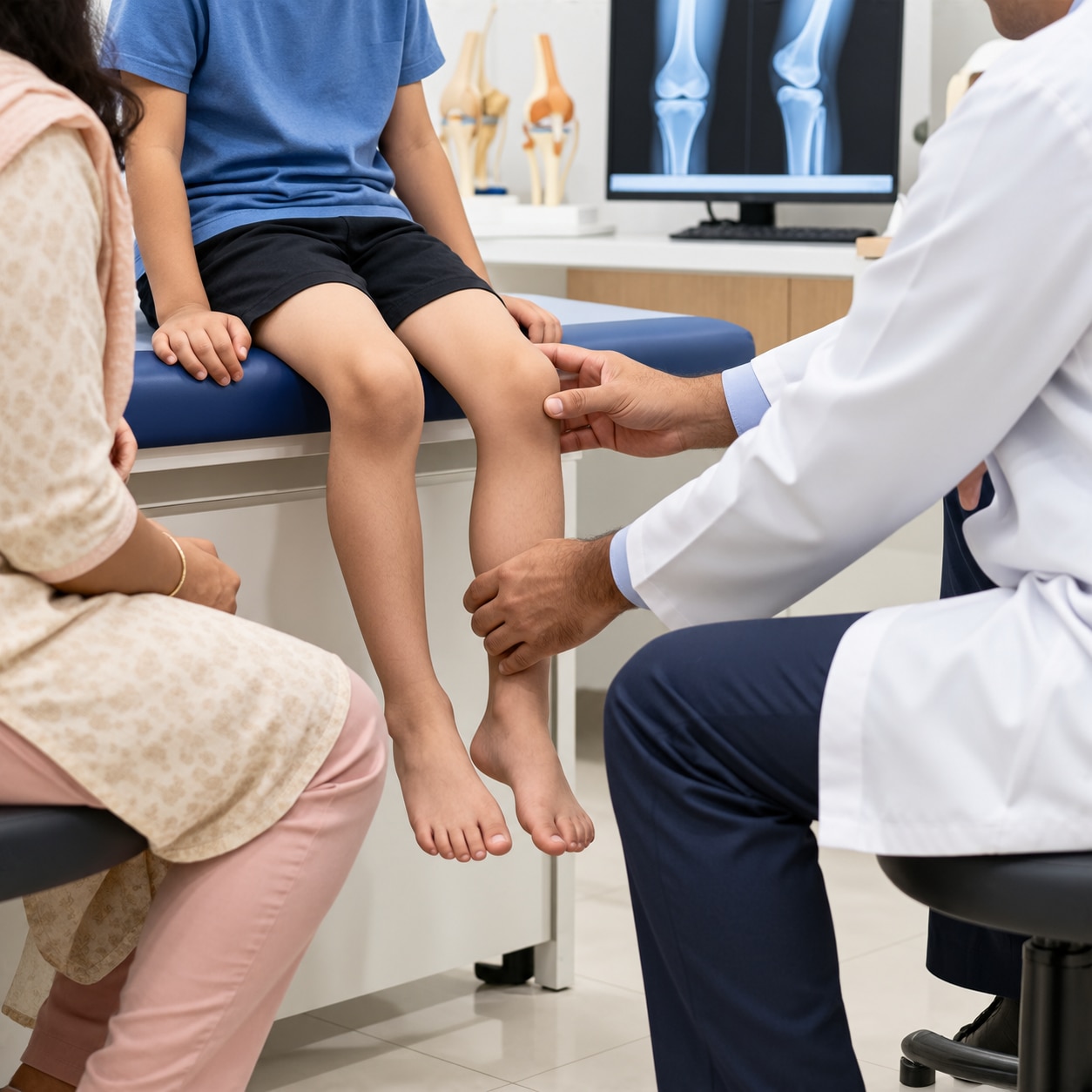
A child’s knees may look bowed or angled inward, but the consultation is not based on appearance alone. The doctor builds a timeline, examines the entire lower limb, decides whether imaging is useful and explains whether the next step is observation, further testing or treatment.
Key takeaways
- Bring growth records, medical history and details of pain or walking changes.
- The examination compares both legs, hips, knees, ankles, gait and limb lengths.
- X-rays depend on age, alignment, symptoms and whether the deformity is progressing.
- Pain, swelling, fever, injury or sudden change can make assessment more urgent.
What happens when you arrive and answer the doctor’s questions?
A child knee deformity consultation in Bengaluru usually begins with the child’s age, height, growth pattern and developmental history. The doctor is trying to separate age-appropriate alignment from a condition that needs investigation.
1. You will be asked when the alignment change was first noticed, whether it is worsening, and whether both legs look alike. Describe pain, limping, falls, fatigue, difficulty keeping up with play, and problems during running or sports.
2. Expect questions about an earlier injury or infection, relatives with similar leg alignment, diet, medical conditions and current medicines. Poor nutrition, digestive disease, kidney problems or other details can point toward metabolic bone disease, so mention them clearly.
3. Bring the records that help the doctor compare today’s appearance with earlier growth and treatment:
- Previous X-rays and written reports
- Treatment records, including physiotherapy or braces
- A list of current medicines and supplements
- Height and weight records, or the child’s growth chart
- Photographs or short videos of the child standing, walking or running
Record roughly when you first noticed the change and whether it followed an illness or injury. Let the child stand and walk naturally for any photographs. Do not pull, strap or force the legs straight before the appointment; that can hide the resting alignment and make the examination less accurate.
How does the physical examination measure the whole lower limb?
The doctor measures the whole lower limb, not just the knee. They watch your child stand and walk from the front, back and side, noting pelvic tilt, knee direction, foot position and whether the alignment changes during movement.
- Move the hips, knees and ankles through their range of motion.
- Examine the feet and ankles for position, flexibility and support.
- Compare both legs, including apparent length differences and muscle bulk.
- Assess rotational alignment by observing the kneecaps, feet and walking pattern.
- Check strength, sensation and pulses when pain, weakness, injury or circulation concerns make those checks necessary.
For knock-knee alignment, the doctor may bring the knees together and measure the gap between the inner ankles, called the intermalleolar distance. For bow-leg alignment, they may bring the ankles together and measure the gap between the inner knees, called the intercondylar distance. Neither distance diagnoses deformity alone.
Age, sex, height, symmetry, progression and the mechanical axis determine its significance.
A knee angle can originate higher at the hip or lower at the ankle, so the examination follows the entire limb. This same process forms the core of a child orthopaedic assessment HSR, whether the child has pain or only a visible change in alignment.
When are X-rays or blood tests part of the consultation?
The doctor investigates immediately when alignment is severe, clearly one-sided, worsening, painful, outside the expected age pattern, or linked with short stature or an unusual growth pattern. A symmetrical, painless appearance that matches normal developmental stages is more likely to be monitored than X-rayed at the first visit.
| Finding | Usual next step | Why |
|---|---|---|
| Symmetrical, age-appropriate alignment | Observe and review | Avoids an unnecessary radiation test |
| Severe, one-sided or progressive alignment | Standing, weight-bearing imaging | Documents the deformity and guides treatment planning |
| Suspected leg-length difference or angular deformity | Full-length lower-limb X-ray | Shows the hips, knees and ankles together |
A knee-only X-ray cannot show the full hip-to-ankle mechanical axis. When the doctor needs to locate an angular deformity or measure leg-length difference, a standing, weight-bearing full-length lower-limb X-ray is more informative; the exact views depend on the child’s age and suspected condition.
Blood tests are not routine for ordinary developmental bow legs or knock knees. During a paediatric orthopaedic consultation in Bengaluru, the doctor may request calcium, phosphate, alkaline phosphatase, parathyroid hormone and vitamin D-related tests when the history or examination suggests rickets, renal disease, malabsorption or another metabolic bone disorder.
The test choice follows the suspected cause, rather than the visible angle alone.
What findings make the appointment more urgent or more complex?
Inability to bear weight, fever, or a child who appears unwell should not wait for a routine review. Seek prompt medical assessment if sudden severe pain, marked swelling, or rapidly worsening alignment develops.
Other warning signs include a strongly one-sided deformity, pain that wakes the child at night, unexplained weight loss, persistent fatigue, or other systemic symptoms. These findings can point beyond normal developmental alignment and change how quickly imaging or blood tests are considered.
| Finding | Why it matters | Action |
|---|---|---|
| Unable to bear weight | May indicate significant injury, infection, or acute joint pathology | Arrange prompt assessment |
| Fever or unwell appearance | Raises concern for infection or systemic illness | Seek urgent medical advice |
| Night pain or weight loss | Needs evaluation for causes beyond ordinary alignment variation | Do not delay review |
| Stable, painless, symmetrical appearance | Fits a planned assessment when function is normal | Book a routine appointment |
An orthopaedic consultation for adolescents in Bengaluru may cover more than the visible knee angle. The doctor may ask about patellar instability, sports-related pain, hip symptoms, rotational deformity, limb-length difference, and remaining growth. A near-mature skeleton leaves less time and fewer growth-based treatment choices, so the plan may differ from one for a younger child.
A stable, painless appearance without progression or functional limitation can usually be assessed through a planned appointment. Rapid change, marked asymmetry, or whole-body symptoms calls for earlier contact.
How does the doctor explain the next step after the examination?
The next step depends on the pattern, not the appearance alone. The doctor combines when the change began, whether it is progressing, the examination of both legs, the child’s growth stage and any imaging before recommending a plan.
1. If alignment is symmetrical, painless and appropriate for age, observation is usually safest. The doctor will set a review interval and explain what change should prompt an earlier visit.
2. If the findings are unusual, worsening, one-sided, painful or linked to short stature, the doctor may order a standing full-length X-ray or blood tests for suspected metabolic bone disease.
3. Physiotherapy may help strength, balance, gait or a separate functional problem. Corrective shoes, wedges and routine braces do not reliably straighten typical developmental bow legs or knock knees, so using them without a diagnosis adds cost without correcting the growth pattern.
4. For progressive deformity such as Blount disease, a growing child may need guided growth near a growth plate. An older adolescent or a severe fixed deformity may instead require corrective osteotomy, which reshapes and realigns the bone.
A knee deformity doctor for children in Bengaluru, including Dr Harish Madrekar's Orthopaedic Clinic, should explain how the hip, knee and ankle fit together, what evidence supports the recommendation and exactly when review is due. Ask those questions before agreeing to treatment.
Related service
KNEE DEFORMITY CORRECTION IN CHILDREN Knee deformities in children and adolescents can affect the alignment, growth, walking pattern and long-term function of the lower limbs. View service → |
Frequently asked questions
What questions will the doctor ask during a child knee deformity consultation?
The doctor will ask about the child’s age, height, growth pattern, developmental history, pain, walking changes, injuries and when the alignment first became noticeable.
What does the physical examination measure?
The doctor observes gait and examines both legs, hips, knees and ankles, comparing alignment, range of motion, limb length, muscle development and tenderness.
When are X-rays or blood tests needed?
X-rays are considered when the deformity is pronounced, asymmetric, painful, worsening or outside the expected age pattern. Blood tests are considered when infection, inflammation or another systemic condition is suspected.
What makes a child knee deformity appointment more urgent?
Urgent assessment is important after significant injury or when the child has sudden deformity, severe pain, swelling, fever, inability to bear weight or a rapidly changing alignment.
How is the next step explained after the examination?
The doctor explains whether the alignment fits the child’s age, whether observation, follow-up measurements, imaging, blood tests or treatment is appropriate, and which changes should prompt an earlier review.
Keywords