A sudden fall onto the shoulder during sports, cycling, or even a road accident can result in an acromioclavicular (AC) joint injury. Many people mistake this condition for a simple shoulder sprain and delay treatment, only to experience persistent pain, weakness, and difficulty lifting the arm.
Understanding acromioclavicular (AC) joint dislocation treatment helps patients recognize when an injury needs medical attention and what recovery typically involves.
What Is the AC Joint?
The acromioclavicular joint is where the collarbone (clavicle) meets the highest part of the shoulder blade (acromion). Strong ligaments stabilize this small but important joint, allowing smooth shoulder movement.
An injury occurs when these ligaments stretch or tear after direct impact, causing the collarbone to shift out of its normal position.
Common Causes of AC Joint Dislocation
This injury commonly affects people involved in physical activities but can happen to anyone.
Typical causes include:
- Falling directly on the shoulder
- Contact sports such as football or rugby
- Bicycle and motorcycle accidents
- Gym injuries
- Slipping on wet floors
- Workplace accidents
In Bengaluru, orthopedic specialists frequently see AC joint injuries among athletes, fitness enthusiasts, and individuals involved in daily commuting accidents.
Symptoms to Watch For
Symptoms usually appear immediately after injury.
These may include:
- Sharp pain over the top of the shoulder
- Swelling around the collarbone
- Visible bump near the shoulder
- Pain while lifting the arm
- Reduced shoulder strength
- Difficulty carrying bags
- Pain during overhead activities
Some mild injuries allow limited movement, while severe dislocations may significantly restrict arm function.
How Doctors Diagnose the Injury
Accurate diagnosis begins with a detailed examination.
The orthopedic specialist checks:
- Tenderness over the AC joint
- Shoulder stability
- Arm movement
- Visible deformity
- Pain during specific shoulder tests
Imaging often confirms the diagnosis.
Investigations may include:
- Digital X-rays
- Stress X-rays when required
- MRI scans if ligament or muscle damage is suspected
- CT scan for complex injuries
Proper imaging also helps classify the severity of the dislocation.
Types of AC Joint Injuries
Doctors generally classify these injuries into different grades.
Mild Injury
The ligaments are stretched but remain intact.
Moderate Injury
Some ligament tearing causes partial displacement.
Severe Injury
Complete ligament rupture allows the collarbone to move significantly, often creating a noticeable prominence.
Treatment depends largely on the severity rather than appearance alone.
Treatment Options
Most mild and moderate injuries improve without surgery.
Conservative management may include:
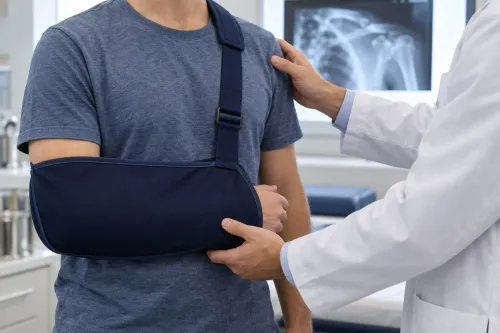
- Shoulder sling
- Ice application
- Pain-relieving medications
- Anti-inflammatory treatment
- Early physiotherapy
- Progressive strengthening exercises
Patients usually regain normal shoulder function with structured rehabilitation.
Severe injuries may require surgery, especially for:
- Professional athletes
- Heavy manual workers
- Persistent instability
- Cosmetic concerns
- Chronic pain despite rehabilitation
Modern surgical techniques focus on restoring ligament stability while preserving shoulder movement.
Why Physiotherapy Matters
Healing does not end once pain decreases.
Rehabilitation helps restore:
- Shoulder strength
- Range of motion
- Joint stability
- Muscle coordination
- Sports performance
Skipping therapy increases the likelihood of stiffness and repeated injuries.
Recovery Timeline
Recovery varies depending on injury severity.
Many patients experience:
- Pain improvement within a few weeks
- Gradual return to office work
- Progressive strengthening over several months
- Return to sports after adequate healing
Returning too early can slow recovery or worsen the injury.
Can AC Joint Injuries Be Prevented?
Although accidents cannot always be avoided, certain precautions reduce risk.
Helpful measures include:
- Strengthening shoulder muscles
- Learning proper falling techniques
- Wearing protective sports equipment
- Using correct lifting techniques
- Maintaining flexibility
- Following supervised fitness programs
When Should You See an Orthopedic Specialist?
Medical evaluation becomes important if:
- Pain persists beyond a few days
- A visible shoulder bump develops
- Arm movement remains restricted
- Shoulder feels unstable
- Weakness interferes with daily activities
- Pain returns during exercise
Early diagnosis often prevents long-term shoulder dysfunction.
For patients seeking specialized orthopedic care in Bengaluru, Dr Harish Madrekar's Orthopaedic Clinic evaluates shoulder injuries using detailed clinical assessment and modern imaging to determine the most appropriate treatment plan. Timely evaluation helps patients recover safely while minimizing future shoulder problems.
Keywords